login

OPAIC Shaping Learner & Staff Capability

OPAIC Destination Unique Learner Experience Reflective Practitioners Contemporary Qualifications Capability
Learner Capability

Building Unlocking Learner Capability

Evidence & action based experiential learning

Customisable performance tracking

Learner-centred service redesign enabling learner capability

World-class capability performance framework & profile
Learner Lifecycle Experience

Exciting learning discoveries

Collaboration with industry & community

Skilful & Reflective Learners

Breaking New Ground in Assessment Design

Creatively Capable
Co-Creating Learner & Staff Capability

Staff PD, observations analysis

Flexible Curriculum Problem based learning Work placements & Internships

Reflection ‘in’ & ‘on’ learning "Prior learning"

Assessment grounded in skills for industry

People focus & skills for lifelong development, Achieving breakthrough EPI performance
Learning And Teaching Strategy

OPAIC Unique Curriculum

Experiential Learning & PBL

Capturing Learner Progress

Capability Driven Assessment

Work Ready & Sustainable Practitioners

Designed by parneet kaur Dhindsa, Navjot Kaur & Divya

Otago Polytechnic

Learner Capability
Requires experience, feedback and evidence. It is knowing how to learn and where to access learning information and skills.
Learning how to upskill, become a life-long learner, being innovative, becoming focused on being employable, preparing to sell yourself to an employer.
Creating Learners who have a responsible attitude towards employment.
1. Learners are actively engaged in the Learner Capability Framework and understand what they need to do to build their capability profile.
2. Learners are digitally literate, can seek further information, resources and data to support their achievement and build their capability profile.

How We Do It
Otago Polytechnic

Building Unlocking Learner Capability
VISION: New Zealand’s premier destination for international (business) students.
• Outstanding programmes: unique points of difference in the curriculum, a strong focus on learner capability.
• Outstanding and caring academic and support staff: diverse, experts in their field, international and industry experience.
• Outstanding campus: facilities, campus culture, campus life.
• Experiencing the best of Auckland and New Zealand.
• Connected with industry.

How We Do It

Otago Polytechnic

Learners will have an exceptional learner experience
GOAL: Provide learners with an exceptional learner experience
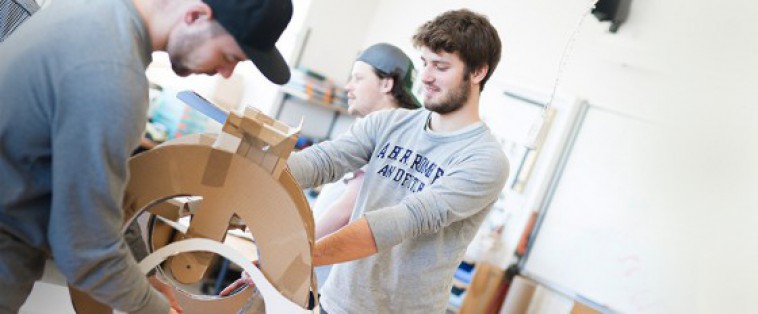
Students in real activity
Each learner will be able to obtain generic and specific capabilities that suit their ambitions, talents and needs.

How We Do It

Otago Polytechnic

Students will assess and track their progress.
Goal: Students assessing and tracking their progress
Each learner will be equipped to continue learning and assessing their performance independently.
How we develop Global Capability and Work-Ready Graduates
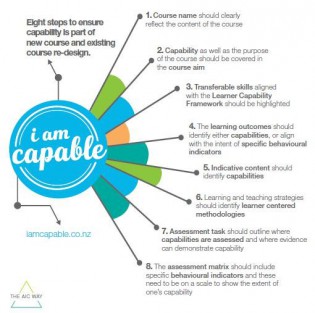
1. Customised proactive performance tracking allows our graduate’s to track their capability (LC framework).

2. The core characteristics of being capable have been identified for each major discipline area to help graduates meet employer expectations.
3. Strong focus on ‘ability’, ‘readiness for work’ and ‘know how’ in all courses and qualifications.
4. Capability is tracked through course and qualifications mapping).

How We Do It

Otago Polytechnic

Focus: OPAIC qualifications will provide skills, knowledge and capabilities that meet an ever changing work environment.
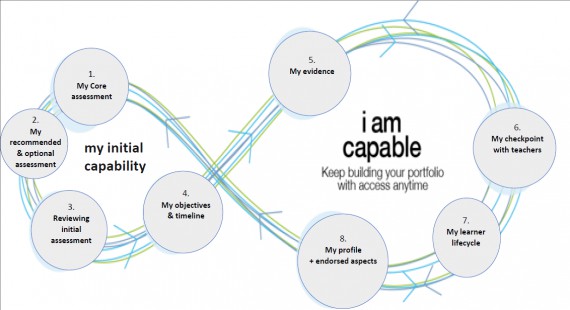
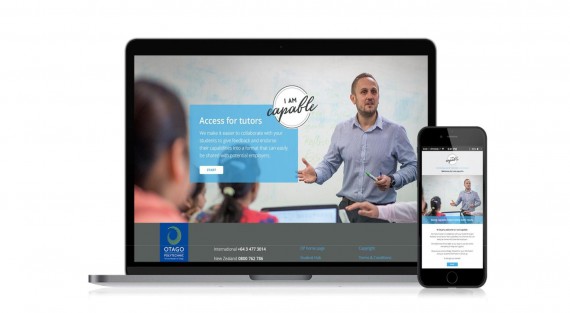
Goal: Develop and implement an online ‘iamcapable’ tool to allow AIC learners to monitor and develop their capability for employment
PRIORITY: Diversify programme portfolio, introduce new programmes & re-design curriculum towards learner capability.
OUTCOMES:
1. Student currency in terms of qualification
2. Staff professional development focus on curriculum redesign to assist learner capability.
3. All OPAIC qualifications will demonstrate and measure real world capabilities possessed by their graduates.

How We Do It

Otago Polytechnic

New Zealand’s most employable international graduates.
Goal: Build capability for a global workforce.
PRIORITY:
To deliver programmes which build learner capability for a global workforce.
AIC Successful Graduates will be equipped for:
1. The changing nature of work.
2. The new careers yet to be created.
3. The essential skills for graduates to participate in work.
4. International mobility of learners and graduates.
Framework URL
Employer feedback
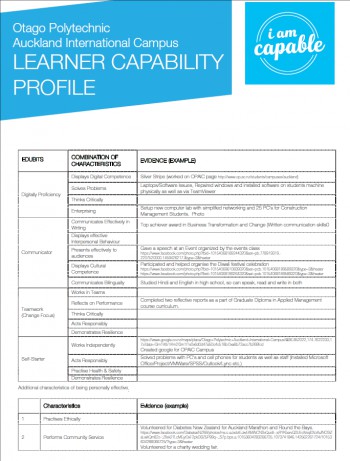
Profile (example)

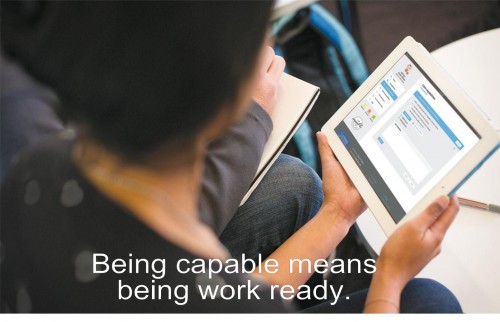
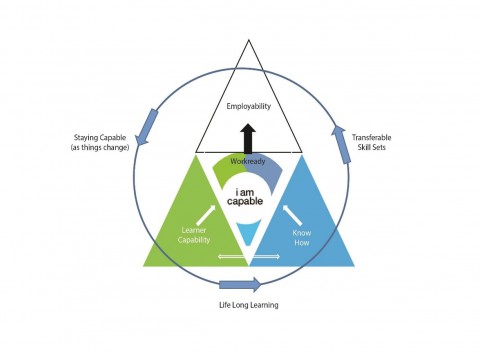
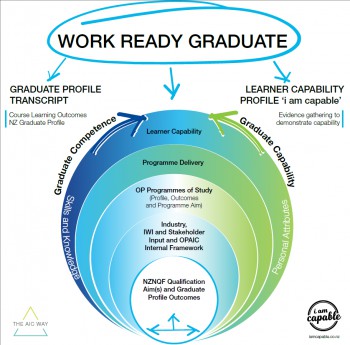
Being capable is being work ready
• To be work ready you need a range of Interpersonal capability, personal capability, intellectual capability and key skills & knowledge.
• A work ready graduate understands the role they might take within a business and the transferable skills to stay employable.
• Your employability relates to your aptitude/capability/ talent/ proficiency & skill.

How We Do It

Otago Polytechnic

Students’ learning will be gained from a range of real world experiences and personal discoveries.
PRIORITY: Strengthen student induction to NZ and for successful study at OPAIC.
Student stories
Experiences & what learners have discovered
Students finding out what they know and what they can do.
Students on OPAIC programmes will be able to learn and develop a coherent set of capabilities that they take responsibility for.

How We Do It

Otago Polytechnic

Assist students to build strong connections with industry and business.
GOAL: Build strong connections with industry and business.
Strategic intent:
a. Developing a highly collaborative and dynamic employability centre aligned with business.
b. Provide internships and work placements to high performing learners completing their learner’s capability profile.
c. Ensuring that evidence of learner capability is aligned with industry expectations and driven by industry feedback & research.
Description of the contexts and learning environments used by AIC
Learners will develop their capabilities with programmes involving real world experiences and projects within their preferred fields, industries and local communities.
Establishing Collaborative Partnerships, Internships and Workplace Experiences
1. Workplace internships to utilize, practice and gather feedback on a range of work ready skill sets will provide evidence to demonstrate learner capability.

How We Do It

Otago Polytechnic

Students will become skilfull and reflective practitioners capable of reviewing and analysing their own practice.
GOAL: To develop skilful & critically reflective practitioners
Reflection
• Opens minds
• Challenges attitudes and values
• Helps confront other views and reconstruct ideas
• Develops a critical consciousness
Techniques, tools & behavioural indicators Examples of: Learners critically reviewing their actions, seeking feedback from colleagues, exploring how they could improve their performance and implementing changes.
Learners seeking and take learning opportunities to improve their skills, knowledge and performance.
Learners will gain an integrated, balanced and practical set of capabilities by making use of reflective learning practices

How We Do It

Otago Polytechnic

Students will develop their confidence with unfamiliar problems and learning situations that will shift their thinking and change their behaviour.
PRIORITY: Deepen engagement with business and other key influencers.
Shifting learner thinking & behaviour change
What is behaviour change?
How we shift behaviour at AIC?
Students will be directly involved in building and assessing the capabilities of their own graduate qualification.

How We Do It

Otago Polytechnic

Students will become confident independent and capable contributors in many work situations.
  GOAL: Learners understand what it means to be creatively capable
Students will be developing and assessing their own capabilities
Learners building their own capability
1. Learners are able to identify the capabilities and describe the behavioural indicators they need to be capable and work ready.
2. Learners understand how their course of learning relates to learner capability and how the range of experiences and opportunities will provide evidence to demonstrate their level of performance.
3. Learners can identify their learning need, success criteria and next steps to ensure they meet the behaviour indicators to demonstrate their capability.
4. Learners can describe the key concepts behind experiential learning and the relevance of this style of learning in developing their capability.
5. Learners are consistently reflective and checking their capability performance with staff to ensure their learning needs are being met.

How We Do It

Otago Polytechnic

Staff and student research culture will be based on building the skills, knowledge and capabilities that develop work ready graduates.
GOAL: Commence development of a research culture, integrated with teaching and learning with a focus on employability
PRIORITY: Implement a staff development programme, aligned to the campus priorities.
The OPAIC programme design will be developed, evaluated and continuously improved though a unique partnership between staff and students.
Cooperative teams

How We Do It

Otago Polytechnic

OPAIC will ensure leading edge learning and teaching with a strong emphasis on development of learner capability through experiential learning approaches.
GOAL: Ensure leading edge learning and teaching.
PRIORITY: Learning redesign to embed unique curriculum and learner capability:
– Develop, assess and report on learner capability.
– Introduce PBL
– Introduce blended learning
– Introduce on-line formative assessment

How We Do It

Otago Polytechnic

The importance of reflective practice will be emphasised to build both learner and teacher capability and practice.
GOAL: Reflection is used to help learners make meaning of experience, ideas, emotions and actions.
Reflection “in” action occurs during the experience. Reflection “in” action is often unsupported and occurs in the midst of action as individuals try to make sense of what is happening (Beard and Wilson, 2002, p.197).
Reflection “on” action is about thinking after an experience is finished.
Reflection “on” action is a technique used in a structured settings to explore an experience in retrospect.
Programme and course design will include reflective practice to ensure that learners build and increasingly take full responsibility for their own learning, development and assessment throughout their studies.

How We Do It

Otago Polytechnic

Qualification outcomes will directly build towards capabilities needed for graduate employment.
GOAL: The learner capability behavioural indicators will reflect employer needs and expectations
Qualification outcomes and related assessments will directly, and progressively build towards capabilities needed for graduate employment.

How We Do It

Otago Polytechnic

Student and staff collaboration increases learner and teacher capability and practice that leads to increased work opportunities.
GOAL: Achieve outstanding levels of learner success (academic, employment)
Students and staff will progressively come to understand the significance, stability and longevity of capability based programme design

How We Do It

Otago Polytechnic

OPAIC to become New Zealand’s premier destination for international students.
GOAL: Develop and expand the 6 key drivers that support the AIC WAY
What are the unique points of difference
1. Embedding Experiential Learning & Behaviour Change.
Experiential learning – problem and/or project based (PBL).
2. Developing Global Capability and Work-Ready Plus Graduates.
a. Development of learner capability, including sustainable practice.
b. Business improvement and excellence focus.
3. Designing Dynamic and Inspiring Learning
a. Learning environments will be co-designed with learners and industry to model and achieve experiential learning and learner capability outcomes.
4. Establishing Collaborative Partnerships, Internships and Workplace Experiences for learners completing their capability profile
a. Work integrated learning - internships and industry projects
5. Excellence in Service Provision and living our AIC values
a. Ensure a high performing and collaborative Student Success team that delivers valuable pastoral care and learning support to all learners’.
6 Effective Communication and marketing
a. Develop a highly capable marketing team that promotes AIC as an exciting learning destination.
b. Effective communication with learners to ensure we are meeting their needs, highlighting opportunities and addressing important AIC community issues.

How We Do It

Otago Polytechnic

Experiential learning underpins our learning and teaching process and functionality in all courses, qualifications and learning activity.
GOAL:
Embedding Experiential Learning & Behaviour Change
• Experiential learning underpins our learning and teaching process and functionality in all courses, qualifications and learning activity.
• Reflective practitioners (graduates) who are creative and can problem solve.
• Reflective staff who use inquiry based learning to improve their own practice.
• Learning experience focus on both graduate knowledge and capability (know-how).
• We track (map) experiential learning activity in courses and qualifications to help us determine how we build learner capability.
• Emphasis on problem and/or project based learning (PBL).
• Work integrated learning - internships and industry projects.

How We Do It

Otago Polytechnic

OPAIC will provide a comprehensive online tool and service to capture learner development and achievement.
Goal: Create an online profile that provides evidence of learner capability
Direct link
The LC capability tool

How We Do It

Otago Polytechnic

OPAIC assessment focuses on dilemma based assessment to build learner capability
Goal: Develop assessment that focuses on learner capability
Assessment savvy learners
1. Learners understand the importance of both formative and summative assessment techniques and the function they play in building learner capability.
2. Learners contribute to assessment decisions, technique, timing and criteria for marking.
3. Learners understand the importance of the assessment process, feedback and the data this provides to help them assess their own performance.
4. Learners are comfortable with both self and peer assessment techniques and can use these to assess their own and others progress.

How We Do It

VtTA

Otago Polytechnic

OPAIC is determined to produce both work ready and sustainable practitioners.
GOAL: Create work ready graduates who are also sustainable practitioners
Nurturing Sustainable Practitioners
a. Sustainable practice will be embedded into all AIC qualifications with a strong focus on the interconnectedness, complexity and competing demands of environmental, social, compliance and economic factors in business, organisational and community decision making.
b. Strong focus on understanding the needs of future generations and maintaining their access to resources.
c. The principles of behaviour change, identifying key problems, problem solving and implementing actions that make a difference will be a stronger feature of learner capability (evidence and assessment).
Sustainable Practitioners

How We Do It

Otago Polytechnic

UNIQUE Learner Experience
Strategic intent:
1. Creating unique learning experiences for graduates.
2. Creating flexible learning spaces to support a problem based and experiential learning driven curriculum.

How We Do It

Otago Polytechnic

OPAIC Destination
Compelling reasons to study at OPAIC
• Outstanding programmes: unique points of difference in the curriculum.
• Outstanding and caring academic and support staff: diverse, experts in their field, international and industry experience.
• Outstanding campus: facilities, campus culture, campus life.
• Experience the essence of multi-cultural Auckland and New Zealand.
• A programme that is connected with industry and offers work placements for outstanding learners.

How We Do It

Otago Polytechnic

Contemporary Qualifications
Strategic Intent:
a. Capturing learner progress on a world class capability performance framework profile.
Learners are:
1. Able to regularly update and submit evidence of their capability for review, and present their summary to staff at regular intervals to ensure they are building their learner capability profile.
2. Able to electronically produce a learner capability profile at the conclusion of their qualification that highlights what they can do with appropriate evidence.

How We Do It
Otago Polytechnic

How We Do It
Strategic intent:
Learner-centred teaching methods shift the focus of activity from the teacher to the learner. At OPAIC, these methods include experiential learning, in which students are engaged in activities and tasks that emotionally engage them and involve self-reflection focussing less on knowledge acquisition and more on building potential and increasing capacity of learners to perform effectively in the workplace; cooperative learning, in which students work in teams on problems and projects under conditions that assure both positive interdependence and individual accountability; and inductive teaching and learning, in which students are first presented with challenges (questions or problems) and learn the course material in the context of addressing the challenges. Inductive methods include inquiry-based learning, case-based instruction, problem-based learning, and project-based learning.
Experiential learning underpins our learning and teaching process and functionality in all courses, qualifications and learning activity at OPIAC which would lead to developing our learners to be Reflective practitioners (graduates) who are creative and can problem solve.
Embedding Experiential Learning & Behaviour Change
1. Experiential learning underpins our learning and teaching process and functionality in all courses, qualifications and learning activity.
2. Reflective practitioners (graduates) who are creative and can problem solve.
3. Reflective staff who use inquiry based learning to improve their own practice.
4. Learning experience focus on both graduate knowledge and capability (know-how).
5. We track experiential learning activity and how that builds learner capability (mapping).

How We Do It
Otago Polytechnic

How We Do It
Strategic Intent:
a. Capturing learner progress on a world class capability performance framework profile.
Learners are:
1. Able to regularly update and submit evidence of their capability for review, and present their summary to staff at regular intervals to ensure they are building their learner capability profile.
2. Able to electronically produce a learner capability profile at the conclusion of their qualification that highlights what they can do with appropriate evidence.

How We Do It
Otago Polytechnic

Capability
Vision: New Zealand’s most employable international graduates.
Strategic Intent:
a. Developing capable work-ready plus graduates.
b. Developing work-ready sustainable practitioners.

How We Do It

Otago Polytechnic

Learner Lifecycle Experience
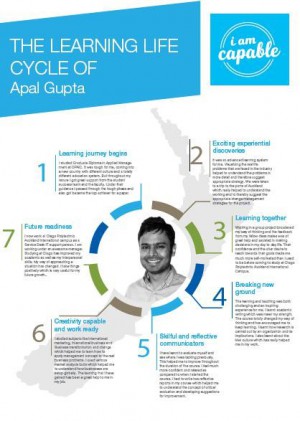
Guiding our students through a formative time in their lifelong learning journeys is a special privilege. At Otago Polytechnic Auckland International Campus, they engage in an experiential learning process and emerge as capable, work-ready practitioners.
The lifecycle process follows the learner’s journey from:

1. Learning journey begins: to,
2. Exciting experiential discoveries,
3. Learning together,
4. Breaking new ground,
5. Skilful and reflective communicators,
6. Creatively capable and work ready, and
7. Future readiness

How We Do It

Otago Polytechnic

Reflective Practitioners
Strategic intent:
1. Creating reflective practitioners who are lifelong learners.
Learners as reflective practitioners
1. Learners understand that reflection is evidence based.
2. Learners and staff co-create opportunity for in-depth and regular reflective practice, aligned to the capability framework.
3. Learners are able to reflect individually, with peers and in a wider group to evaluate their progress.
4. Reflective practice addresses both individual learning needs, the changing learning environment, learning as a fun and enjoyable experience, the role of the learner, staff and peers and the issues the affect learning and development.

How We Do It

Otago Polytechnic

Co-creating Learner and Staff Capability
Learners who co-create the learning environment with staff

1. Learners will be active and entrusted participants in co-creating the OPAIC learning environment with staff to meet their own learning needs. Both students and teachers will hold each other to account in developing an active and collaborative learning environment.
2. Learners will be active contributors to learning activity to allow them to meet their capability profile objectives.
3. Learners and staff will have input into course content, assessment methods and choice of experiences as co-creators.
4. As independent learners OPAIC students should make regular contributions to course content and learning experiences in collaboration with staff.
5. Learners know how to use the assessment feedback to reposition their learning to achieve their own learning outcomes.

How We Do It